Blog

  • House Price Appreciation by State and Metro Area in the Second Quarter of 2026

    House Price Appreciation by State and Metro Area in the Second Quarter of 2026

    It’s always interesting to see how house price trends play out across the country—and even more so when you’ve watched the Chicagoland area evolve over decades. In the second quarter of 2026, U.S. home prices climbed 2.1% year-over-year, with 47 states seeing growth. Alaska and Vermont led the way, while New Mexico and Washington saw declines. Looking at metro areas, 75 experienced gains—Elgin, IL stood out with the strongest increase, while Everett, WA posted the largest drop.

    As someone who’s called Lake County home since 1959 and has spent over 20 years guiding clients through the nuances of our local market, it’s rewarding to see a neighboring area like Elgin leading the nation in appreciation. These shifts highlight how critical it is to understand local factors—like employment, transportation, and community dynamics—when assessing property values. Whether you’re looking to buy, sell, or invest, knowing these trends can help you make confident decisions about your next move in Lake, McHenry, and Cook Counties, and the southern Wisconsin region.


    Continue to full article

  • US Confidence Hits Seven-Mo Low

    US Confidence Hits Seven-Mo Low

    It’s interesting to see how US consumer confidence has softened to a seven-month low this mid-Q3, even as people feel a bit better about their current situations. The present-conditions index jumped about 7 points to 121, but the expectations gauge dropped roughly 6 points to 68—dipping beneath a level that’s often flagged as a recession warning. Early in Q3, 23,000 jobs were cut and unemployment nudged up to around 4%. Notably, this shift was more about folks leaving the workforce than it was about a hiring downturn. For those of us closely following the real estate market across Lake, McHenry, and Cook Counties, I’ve noticed that homebuying expectations only eased slightly and continued to climb, even as around 61% of people still anticipated higher interest rates. With federal policymakers keeping rates steady and markets not banking on much short-term relief, borrowing costs are likely to remain elevated through year-end. As someone who’s spent decades helping clients navigate both residential and investment properties in our area, I find it’s times like these that call for careful analysis and local knowledge.

  • More Homes Hit the Market as Demand Cools

    More Homes Hit the Market as Demand Cools

    We're seeing some interesting shifts in the housing market lately. Over the four weeks ending August 23, new listings across the US ticked up by 0.4%, and total homes for sale increased by 0.5%, reaching their highest point since early Q2. At the same time, pending home sales dropped by 1.1%—the lowest in six months. High housing costs are keeping many buyers on the sidelines, even as more inventory becomes available. The median sale price still rose 1.9% year-over-year to over $400,000, with average mortgage rates hovering near 7%, just shy of a 13-month high.

    For buyers, this environment is creating more room to negotiate, especially on homes that have been listed for several weeks—often where the best deals can be found. Sellers are seeing that realistic pricing, rather than chasing last year's highs, is the way to attract serious interest.

    Having lived and worked in Lake, McHenry, and Cook Counties for decades, I know how important it is to have a clear understanding of local trends. Whether you're buying your next home or considering an investment, staying informed about these shifts can help you make the right move for your family or your portfolio.

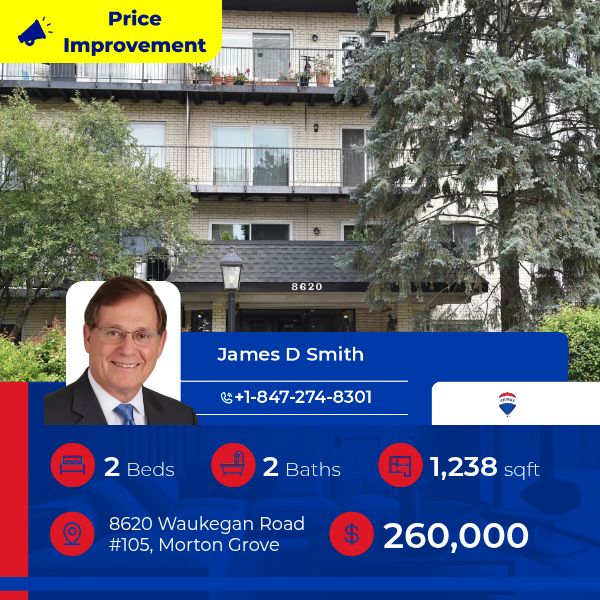
  • Imagine stepping into a bright condo with two cozy bedrooms, two fresh bathrooms, a modern kitchen for meals, open living space, and easy access to transit, shops, parks, and fitness

    Imagine stepping into a bright condo with two cozy bedrooms, two fresh bathrooms, a modern kitchen for meals, open living space, and easy access to transit, shops, parks, and fitness

    Beautiful first-floor condo in the highly desirable Morton Grove Estates! This spacious 2-bedroom, 2-bathroom home features an updated kitchen with room for a breakfast table, a bright and open living and dining room combination, and durable laminate flooring throughout. Ideally located near public transportation, shopping, restaurants, and entertainment, this home offers both comfort and convenience. Enjoy easy access to the park district, recreation and fitness center, and nearby forest preserves, making it perfect for an active lifestyle. Don't miss this wonderful opportunity to own a move-in-ready home in a fantastic location! *** Click on the Virtual tour click on each picture move around and see the full rooms

  • US Luxury Home Sales Vary Widely

    US Luxury Home Sales Vary Widely

    Luxury home sales across the U.S. are truly a study in contrasts—a recent review of public sales data across major markets revealed some remarkable figures, with top transactions ranging from $3.7 million all the way up to $130 million. That $130 million sale sets quite a benchmark, while other notable sales clocked in at $47 million, $40.2 million, $40 million, $21.2 million, $19 million, $18 million, and $17.5 million nationwide. Four major markets still saw their fifth-highest sales all above $10 million, which points to a particularly strong appetite for top-tier properties in those areas. Interestingly, one market stood out for its tight grouping of luxury sales, with its five highest ranging from $24 million to $40 million—suggesting a robust and consistent luxury segment. These numbers reflect only what’s publicly available through listing platforms, so some private transactions or nondisclosure markets may not be fully captured. As someone who has spent decades advising on both residential and investment properties in the Chicagoland region, I find it fascinating how these luxury trends can differ so much by market. If you’re interested in how these dynamics might influence our local opportunities or want a deeper dive into what’s happening in Lake, McHenry, or Cook Counties, I’m always tracking the details to help my clients make well-informed decisions.

  • Hottest Luxury Neighborhoods: 2026

    Hottest Luxury Neighborhoods: 2026

    Luxury neighborhoods across the U.S. are seeing remarkable demand—so much so that available homes simply can’t keep up. In these high-end communities, factors like top-tier amenities, excellent schools, and convenient commutes are fueling highly competitive markets, with sale-to-list price ratios reflecting just how sought-after these areas have become. After 20+ years helping clients navigate the ins and outs of Chicagoland’s most desirable spots—including Lake, McHenry, and Cook Counties—I’ve seen how the right blend of location and lifestyle continues to shape the market. Whether you’re considering a move or an investment, understanding these trends is key to making confident, informed decisions about where to plant your roots or grow your portfolio.

    Continue to full article

  • House Prices Jump in Illinois Amid Slow Pace of New Construction

    House Prices Jump in Illinois Amid Slow Pace of New Construction

    As someone who has called Lake County home since 1959 and spent over two decades advising clients across Chicagoland, I’m seeing firsthand how the housing market is shifting. Chicago's median home price climbed 13.3% to $425,000—a clear reflection of limited inventory in our area. The pace of new construction simply can’t keep up; in fact, it would need to triple to truly address demand. The process is slowed by outdated building codes, permit backlogs, and infrastructure challenges—issues I’ve helped clients navigate time and again. There is some progress on the horizon, with reforms in the works to encourage more affordable, middle-tier housing options. For buyers and investors alike, understanding these local dynamics is essential. My familiarity with residential trends, investment analysis, and neighborhood nuances throughout Lake, McHenry, and Cook Counties helps my clients make well-informed decisions, even as the market evolves.

    Continue to full article

  • U.S. Home Sales Defy Affordability Crunch

    U.S. Home Sales Defy Affordability Crunch

    July’s housing numbers tell quite a story—existing-home sales dropped 1.7%, landing at 4.06 million, while the median price climbed 2% to $434,100. With mortgage rates now at 6.66%, it’s no surprise affordability remains a challenge for many buyers. Interestingly, while the Northeast saw an uptick in sales, activity slowed in the Midwest and South. Having spent decades serving Lake, McHenry, and Cook Counties—and calling Lake County home since 1959—I’ve seen firsthand how local trends can differ from national headlines. Navigating our Chicagoland market requires a sharp eye on both pricing and financing shifts. Whether you’re weighing a move or exploring an investment, understanding these numbers is key to making a well-informed decision.

    Continue to full article

  • USA Starter Homes: A Rare Shift for Buyers

    USA Starter Homes: A Rare Shift for Buyers

    After more than two decades guiding clients through the ups and downs of our local markets, I’ve seen firsthand how challenging it can be for first-time buyers to decide when to make their move—especially when borrowing costs feel high. The truth is, holding out for lower rates doesn’t always play out as hoped. If rates dip, more buyers tend to jump back in, and that renewed competition often drives prices higher. In areas like Lake, McHenry, and Cook Counties—where demand for starter homes is already intense—timing the market can be risky. My approach is always rooted in helping you weigh these factors so you can make the most informed decision for your family’s future.

  • USA: Why ‘Price Stability’ Is a Myth

    USA: Why ‘Price Stability’ Is a Myth

    Having spent decades studying how economic shifts impact our local markets, I’ve seen firsthand that the concept of ‘price stability’ is far more complex than it appears. In the U.S., when the price of one good rises, it often means another price is falling—people shift their spending, rather than pushing all prices up at once. For example, as technology has become more affordable and accessible, limited resources like hotel rooms, sports tickets, and college tuition have grown costlier. This challenges the idea that the central bank can truly control price stability, since global production and daily transactions constantly reshape what things cost.

    A steadier dollar could, in theory, free up investment currently locked in inflation hedges, lowering some prices while pushing up the rarest assets. However, in my experience advising investors and families across Lake, McHenry, and Cook Counties, I’ve found that shifting prices often reflect progress and opportunity—not just economic decline. True, lasting price stability is a myth, but understanding these patterns helps us make smarter choices, whether you’re looking for a home, a commercial property, or your next investment.